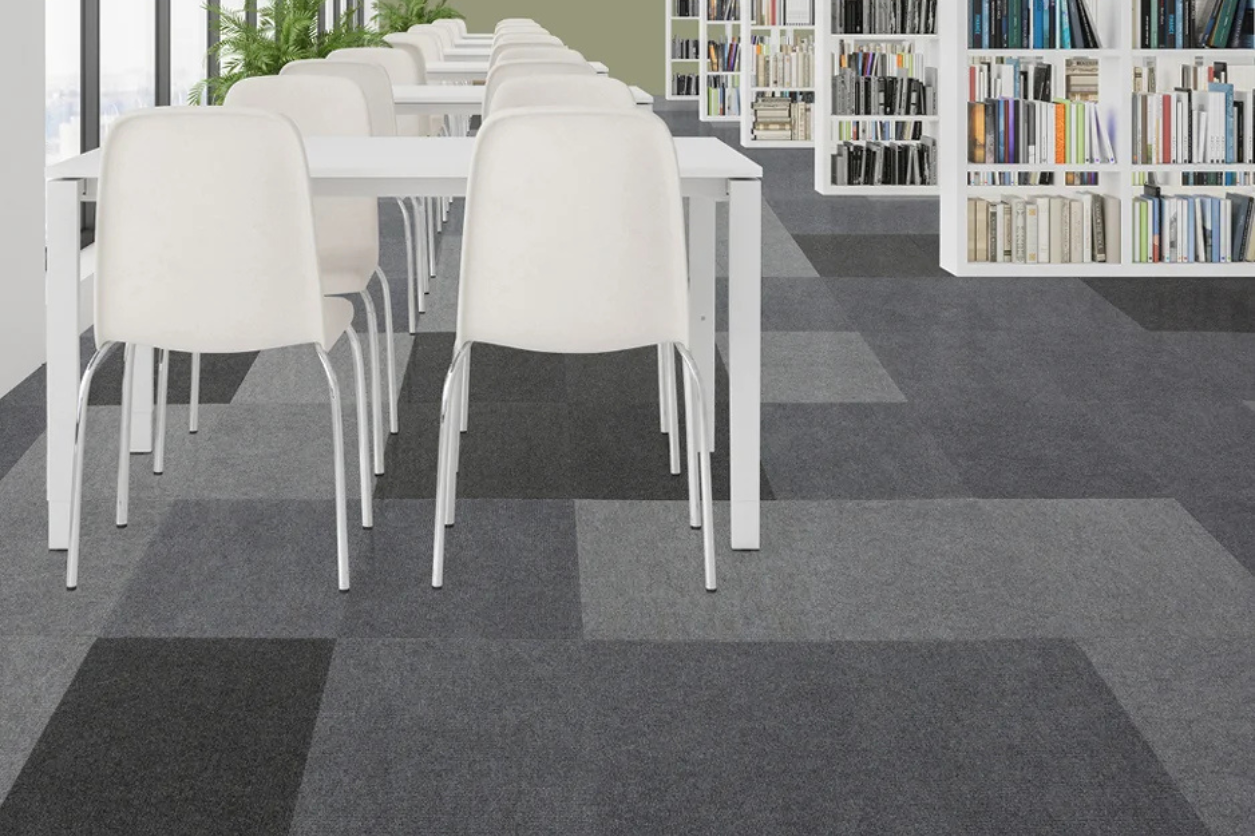
The sheer practicality of carpet tiles is at the forefront of the minds of many customers, given that the right carpet can last for decades, help improve the ambience and wellbeing of the people walking on it and can be easily replaced in hard-wearing areas.
Despite this, even the most practically-minded carpet has a story behind it, whether that comes from its creation, from its intended use or from the context surrounding the people and places for which the carpet served a vital purpose as a comfortable grounding.
Carpet making is a craft and an art form after all, and manufacturers and specialist stores that care about the quality, craftwork and ingenuity that goes into modern carpets will also appreciate the stories in which they play a silent but important part.
Even the oldest carpet in existence, the Pazyryk carpet, is famous as much for surviving thousands of years as it is for the beautiful vibrant colours and incredibly talented weaving skills it demonstrates.
However, there is one notable exception to this rule, as one carpet captivated people with its beauty to the point that they had to know its story, and the result is the most famous pair of carpets ever made.
No Refuge Other Than Your Threshold
The Ardabil Carpets are unusual and incredibly notable Persian carpets that managed, through its beautiful design, nigh-perfect execution and remarkable density of knotting, to captivate onlookers once it was first seen in England in the late 19th century.
Not long after it was bought by carpet dealer Edward Stebbing and described as a “Holy Carpet” originally made for the “Mosque at Ardebil [sic]”, it was bought by the Victoria & Albert Museum. It is still on display there today in Room 42 of the Jameel Gallery in South Kensington.
The story and the sheer beauty of the carpet were enough to captivate textile designer, artist and writer William Morris, then one of the Art Referees at V&A, and he convinced the museum to buy the carpet in 1893 at a cost of £2000 (£218,000 adjusted for inflation).
It was believed at the time to be one of a kind, which made it rather curious when a second, almost identical but fundamentally altered carpet was sold to an American businessman named Clarence Mackay.
The beauty drew people in, but the story behind the pair of carpets is perhaps even more spellbinding.
Remarkable Art Ruined By Connoisseurship
Unpicking the truth from the fiction is almost as difficult as unpicking the carpets themselves, but as far as historians could tell, the Ardabil Carpets were initially two gigantic, identical carpets that were completed over the course of four years of painstaking weaving.
It was thought to have been completed in 1539 or 1540 (Hijri year 946) during the reign of Shah Tahasp I, who was thought to be a patron of carpet weaving in the region. This makes it the earliest known date of any surviving Persian carpet.
They are believed to have been created in Kashan, now in Northern Iran, and were believed to have been created specifically for use in the Sheikh Safi al-Din Kanegah and Shrine Ensemble in the city of Ardabil in North West Iran.
This part of the story is heavily disputed by historians, as it did not appear in any shrine inventory that has been discovered and would not have fit in the shrine at Ardabil. Instead, they are believed to have been designed for the Imam Reza Shrine in Mashad, North East Iran.
Whilst they lasted a while under presumably somewhat heavy use, both were worn by the 1890s and were sold to Ziegler and Company, who used parts of one of the carpets to restore the other to sell to Edward Stebbing, who sold it to the V&A.
Once Mr Morris found out about the second Ardabil, he described the London carpet as remarkable but “compromised” by the market values of art in the 19th century.
At the time, a complete carpet was more valuable than an original carpet, so many historical artefacts and carpets were restored without a great deal of care for originality. It was an era where there was a lot of interest in history, but less about preserving it as it was.
The second carpet was largely a secret kept in various private collections until 1931 when it was revealed for the first time at a London exhibition. It was bought by J. Paul Getty, who eventually donated it to the Los Angeles County Museum in Exposition Park, although other fragments appear on the open market.
The design has since become famous, and several copies have ended up in important places, including Number 10 Downing Street.
If you have any questions or comments, please feel free to get in touch with the CVT Direct team via our Contact Us page or give us a ring on 0345 121 1234.
Browse our flooring and accessories product ranges and use the filters when searching for your new flooring and the accessories needed.